
Why Archers Get Sore (And How to Stay Pain-Free for the Long Haul)
The short answer
Archery soreness comes from repeating a one-sided, static-load movement that concentrates stress in the same places every session. The sore spot is usually covering for a weaker muscle that is not doing its share, so the ache keeps returning no matter how much you stretch it. Treat tightness as information, build up what archery neglects, and progress draw weight gradually so your body has time to adapt.
Archery looks calm. You stand still, you draw, you aim, you release. There is no sprinting, no tackling, no obvious pounding on the body. Compared to almost any other sport, it can look downright peaceful from the outside. So a lot of archers are caught off guard when, a few months in, their shoulder starts aching after sessions, their elbow gets tender to the touch, or a stubborn knot shows up between their shoulder blades that simply will not go away no matter how much they rub it.
Here is the thing most archers never get told: the sport is gentle in appearance and surprisingly demanding in reality. You are holding load, on one side of your body, in nearly the same position, over and over again. A single shot is no big deal. But repeat that shot a few hundred times a week, week after week, and your body will start sending you messages. The reassuring part is that the vast majority of archery aches are not bad luck and they are not inevitable. They are predictable, and once you understand what is actually happening underneath the surface, they are largely preventable.
This post is about that "underneath the surface" part: why archers get sore, why the sore spot is usually a red herring, and two things almost nobody explains to recreational archers, a body-wide tissue called fascia and the role your nervous system plays in how tight or loose you feel. None of it is complicated once it is put in plain language, and understanding it will change how you take care of yourself on the range.
What archery actually asks of your body
To see why aches show up, it helps to be honest about what the sport demands, and three things stand out. The first is repetition: you repeat one very specific movement again and again, so whatever stress that pattern creates gets concentrated in the same places every time, with nowhere to spread out to. The second is that it is one-sided: your draw arm and bow arm are doing completely different jobs in the same instant, so your body is trained lopsidedly, and over time that imbalance adds up. The third is that a lot of it is holding rather than moving: at full draw your muscles are working hard while barely moving at all, and this steady, static effort is sneaky because it does not feel as intense as lifting something heavy, so people underestimate how much it taxes the body. Put those three together and you have a recipe for certain areas getting overworked while others quietly check out. That is the soil archery aches grow in.
The aches are real, but they are usually not where the problem is
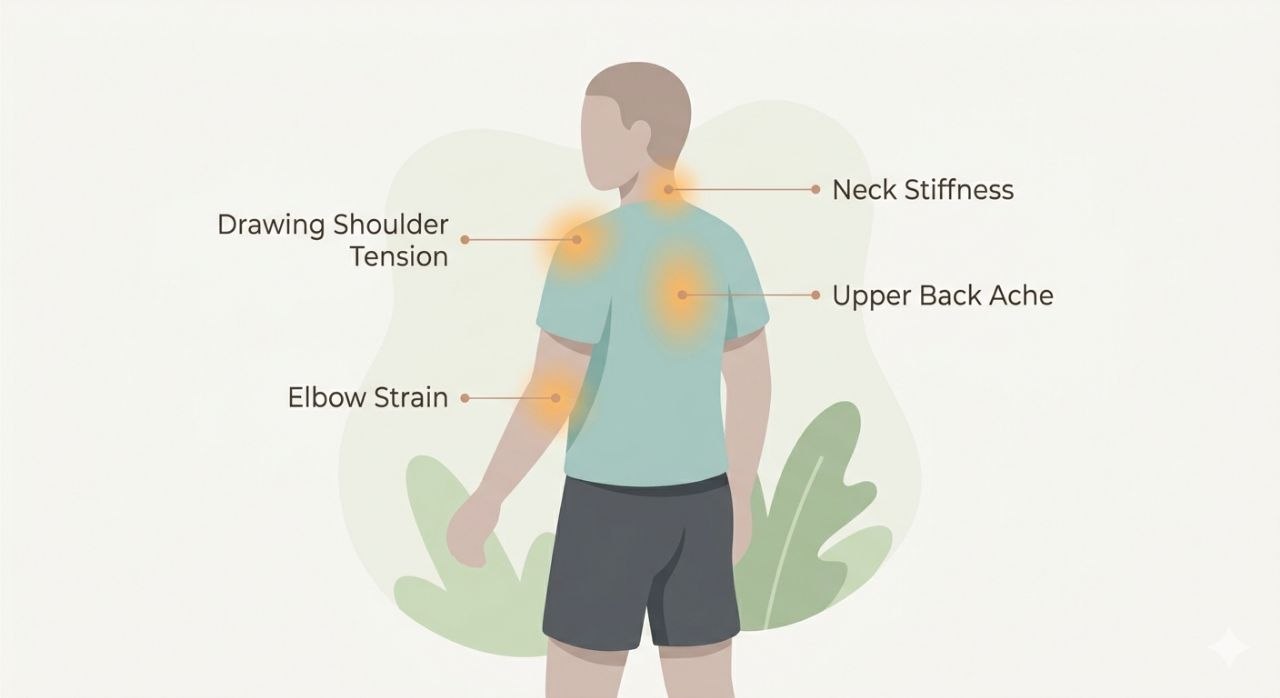
The most common complaints in archery are a sore shoulder, a tender elbow, and tightness across the upper back and neck. It feels completely obvious what to do about them. My elbow hurts, so something must be wrong with my elbow. My shoulder is tight, so I should stretch my shoulder. My neck is stiff, so I should massage my neck.
In practice, this rarely solves anything for long. The spot that hurts is very often just the spot that got stuck doing a job it was never designed to do. Here is how that happens. Your body has big, strong muscles that are supposed to power your shot, mostly across your back and around your shoulder. When those muscles are weak, untrained, or simply not switching on properly, the work does not disappear. It has to go somewhere. So smaller, more delicate structures step in to cover the shortfall. They were never built to carry that load on their own, and predictably, they get overworked, irritated, and start to complain.
So you feel it in your elbow or the front of your shoulder, and you treat your elbow or your shoulder. But those were only ever the messengers. The real issue is that something bigger and stronger was not doing its share. You can stretch and rub and ice that sore spot for weeks, but if you never wake up the muscle that was supposed to be doing the work, the ache keeps coming back. This is why chasing the pain is usually a losing game, and why two archers with identical elbow pain might need completely different solutions.
The smarter question is never "how do I make this spot stop hurting." It is "why is this spot being asked to do so much in the first place."
Meet your fascia, the body's inner fabric

To really understand archery soreness, you need to know about a part of the body most people have never heard of and never had explained to them: fascia.
Picture a thin, stretchy, web-like fabric that wraps around every single muscle, every bone, and every organ you have. If you have ever pulled the skin off a raw chicken breast and seen that pale, slightly slippery, filmy layer underneath, that is fascia. In your own body, this material is not a bunch of separate patches. It is one enormous, continuous, connected sheet that runs from the top of your head all the way down to your toes, almost like a built-in wetsuit worn underneath your skin.
For a long time, this tissue was treated as nothing more than packaging, the stuff that gets in the way when you are looking at the "important" parts. We now understand it is far more interesting than that, because the fact that it is all connected completely changes how we should think about tightness.
Here is the key consequence. A tight feeling in your neck might have very little to do with your neck itself. Because the fascia is one connected web, tension created in one area can be transmitted and felt somewhere else entirely, the same way a snag in one corner of a fitted bedsheet will pucker and pull the fabric several inches away. Your body is not a collection of separate parts bolted together that can be fixed one at a time. It is one connected system, and fascia is a big part of why a problem in one place so often shows up as a feeling in another.
This is the first piece of the puzzle. The second piece is what controls that fabric.
Your nervous system is holding the controls
This is the part that ties everything together, and it is the piece that almost nobody bothers to explain to everyday athletes.
Your fascia is not passive. It is not just shrink-wrap sitting there quietly. It is richly supplied with nerve endings, which means your nervous system is constantly reading information from it, and just as importantly, constantly adjusting it. Your nervous system can increase or decrease the tension in your fascia depending on what it believes your body needs in that moment. In other words, a lot of the tightness you feel is not a fixed, physical state of the tissue. It is a setting, and your nervous system is the one turning the dial.
So why would your own nervous system choose to tighten things up and leave you feeling stiff and restricted? The answer is protection. When your nervous system senses that an area is unstable, weak, or being asked to work too hard, one of its responses is to tighten the surrounding fascia, almost like wrapping a protective brace or a splint around the area. It is not malfunctioning when it does this. It is trying to keep you safe. It has decided that the area cannot be fully trusted, so it locks things down to reduce the risk of something getting hurt.
This single idea explains one of the most frustrating experiences every archer has had. You find a tight, stiff spot. You stretch it. For an hour or two it feels looser and better. And then, reliably, the tightness creeps right back in. People assume they just did not stretch hard enough or long enough. But the truth is usually simpler and more important. The stretch did not fix anything because the tightness was never the real problem in the first place. The tightness was a signal. Your nervous system tightened that area for a reason, and until that underlying reason is addressed, it is going to keep tightening it again, no matter how diligently you stretch.
That is why the most useful shift you can make is to stop treating tightness as the enemy to be defeated and start treating it as information to be understood.
What all of this means for staying healthy
Once you see the body this way, as one connected system, wrapped in a responsive fabric, governed by a protective nervous system, injury prevention in archery stops being about attacking sore spots and becomes something far more effective. A handful of principles will carry you a long way.
Treat tightness as information, not as a problem to crush. If an area keeps getting tight no matter what you do to it, that is your body telling you that something nearby is not pulling its weight, or that an area does not feel stable enough to relax. The fix is almost never to attack the tight spot harder. It is to find and address the weakness or instability that is making your nervous system want to guard in the first place.
Build up the parts of the body that archery quietly neglects. Because the sport pulls you into the same lopsided shape over and over, it tends to overdevelop a few areas and leave others underprepared. Giving attention to the muscles that archery underuses, so that the strong muscles are actually strong enough to do their intended job, takes the load off the smaller structures that have been forced to cover for them. When the right parts are doing the right work, your nervous system has far less reason to brace and guard.
Respect the load you are putting on yourself. A draw weight that is too heavy for your current level of conditioning does not build strength, it builds irritation. A great many archers, eager to progress, shoot far more poundage than their bodies are actually ready for, and the body pays for it slowly and quietly until one day it is not quiet anymore. Progressing your draw weight gradually gives both your muscles and your nervous system the time they need to adapt, instead of forcing them into permanent protection mode.
Warm up to move, not just to stretch. A few minutes of gentle, easy, full-range movement before you start shooting does something more valuable than lengthening a muscle. It sends your nervous system a message that things are stable, supported, and safe. And a nervous system that feels safe is one that is willing to let the fascia relax on its own, which is exactly what you want before you load it up.
Listen early. Soreness that shows up after a hard session and then fades over a day or two is normal feedback and nothing to worry about. Soreness that keeps returning to the exact same spot, session after session, is not random, it is a pattern. Patterns are worth paying attention to while they are still small and easy to address, long before they grow into something that keeps you off the line. If a pattern like that has already set in, it is worth having someone like a registered massage therapist who works on exactly this look at the whole chain, not just the sore spot.
The takeaway
Archery rewards patience on the line, and your body is no different. The aches that sideline archers are almost never really about the spot that hurts. They are about a connected system, a body-wide fabric called fascia that links everything together, and a nervous system that is constantly working behind the scenes to protect you, often by tightening things down when it senses trouble.
Once you understand that, the whole picture shifts. You stop fighting your body and start cooperating with it. You strengthen what is weak instead of beating up what is sore. You respect the load instead of rushing it. You move well before you shoot, you give yourself room to recover, and you treat tightness as a message worth reading rather than a mystery to be endured. None of it is complicated, and none of it requires a medical degree to put into practice.
Do those things consistently, and there is no good reason archery cannot be something you enjoy for decades rather than just a season or two. The archers who stay healthy for the long haul are rarely the ones with the toughest bodies. They are the ones who learned to listen to what their body was telling them, and had the patience to respond well.
Common questions about archery soreness
Why does my shoulder hurt after archery?
Shoulder pain after archery is usually a sign that a stronger muscle group, typically across the back and around the shoulder blade, is not firing properly and a smaller structure is covering the load it cannot handle alone. The shoulder is not the source of the problem; it is the spot that ended up doing more than its share. Strengthening what archery underuses tends to relieve shoulder complaints more reliably than treating the shoulder itself.
Why does the tightness come back after I stretch?
Tightness that returns after stretching is almost always a signal from your nervous system, not a fixed state of the tissue. Your nervous system tightens the surrounding fascia when it senses an area is unstable or overloaded, as a protective response. Stretching temporarily overrides that response without addressing the cause, so the tightness resets. Once the underlying weakness or instability is dealt with, the nervous system stops guarding and the tightness stops coming back.
Is it normal to be sore after archery?
Soreness that appears after a session and clears within a day or two is normal feedback and nothing to worry about. What is worth paying attention to is soreness that returns to the same spot session after session, which is a pattern rather than random fatigue. Patterns like that are the body flagging something that needs attention, and they are much easier to address when caught early before they become a persistent issue.
Written by Josh Kennedy, a Registered Massage Therapist in Durham Region, Ontario, who works with athletes on chronic pain and recurring tension. He runs LYKE Massage, an in-home massage practice.
Tags:
Related Articles

British Columbia Bowhunting Season 2025-2026: Dates, MUs, and Where to Practice
Everything you need to know about bowhunting in British Columbia — archery season dates, Management Units, top ranges from Vancouver to Prince George, and the biomechanics of shooting in the mountains.
Ontario Bowhunting Season 2026: Dates, WMUs, and Where to Practice
Ontario's bowhunting season is one of the most exciting in Canada — but most hunters are leaving success on the table. Learn the 2026 WMU dates, the biomechanics of a clean shot, and the best archery ranges in Ontario to practice before the opener.

The Complete Beginner's Guide to Archery in Canada: Everything You Need to Know Before Your First Shot
New to archery? Our complete beginner's guide covers types of bows, what to expect at your first range visit, 5 essential accuracy tips, and how to find the best archery range near you across Canada.